Bovine
 Equine
 Swine
 Ovine
 Pet




How to use vet color Doppler ultrasound Scanner?
The livestock industry is currently evolving towards scientific and intelligent farming practices. Within this progression, a pregnancy detection device—the veterinary color Doppler ultrasound scanner—has emerged as a vital diagnostic tool. This equipment generates ultrasound waves that produce reflected echoes, which are then processed to form ultrasound images. It supports multiple applications including pregnancy diagnosis, uterine disease screening, and organ examinations. But how should veterinary color Doppler ultrasound equipment be used correctly?

Working Principle of Veterinary Ultrasound
The working principle of veterinary color Doppler ultrasound scannerinvolves emitting high-frequency sound waves and receiving the reflected echo signals from tissues, which are then processed to form images. The equipment first emits high-frequency ultrasonic waves through the Ultrasound Machine Probes, which penetrate the animal's epidermis and enter the internal organs and tissues. Then, the Doppler effect principle is utilized to measure the blood flow velocity and direction, visually displaying the blood flow dynamics within the blood vessels. Finally, the received echo signal is converted to become a grayscale image, and then the color-coded blood flow information is superimposed. This is the principle by which the veterinary color Doppler ultrasound scanner forms color images through detection.
Preparations Prior to Ultrasonic Testing
For animals:
1. Animals must be restrained to ensure operator safety and facilitate smooth procedures.
2. For animals with thicker coats, such as sheep, hair must be shaved from the detection site prior to testing to obtain clearer images.
3. Animals such as cattle and horses undergoing rectal probe examinations require rectal faecal clearance.
Vet Ultrasound Device:
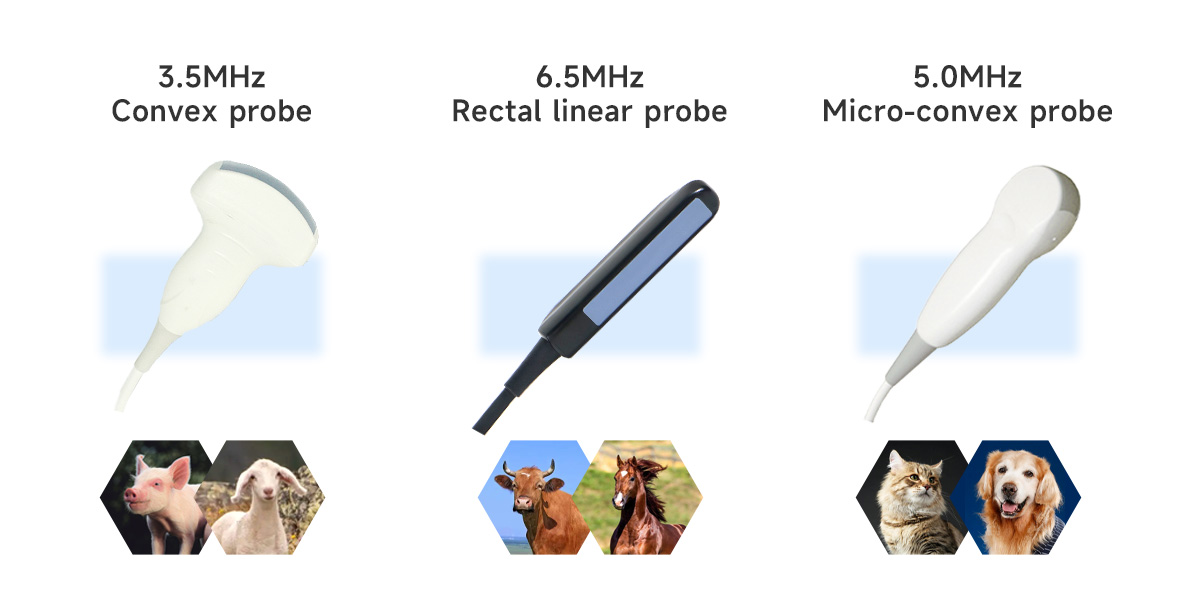
1. Selecting the appropriate probe:
- For pigs and sheep: 3.5 MHz convex probe
- For cattle and horses: 6.5 MHz rectal linear probe
- For small pets (dogs, cats): 5.0MHz micro-convex probe
2. Connect the probe to the main unit (Note: Ensure the main unit is powered off when attaching or detaching probes). Upon startup, the main unit will apply default parameters based on the connected probe. Alternatively, adjust parameter values and examination modes (B/C/PW/M, etc.) according to requirements per the manual.
Detection Process
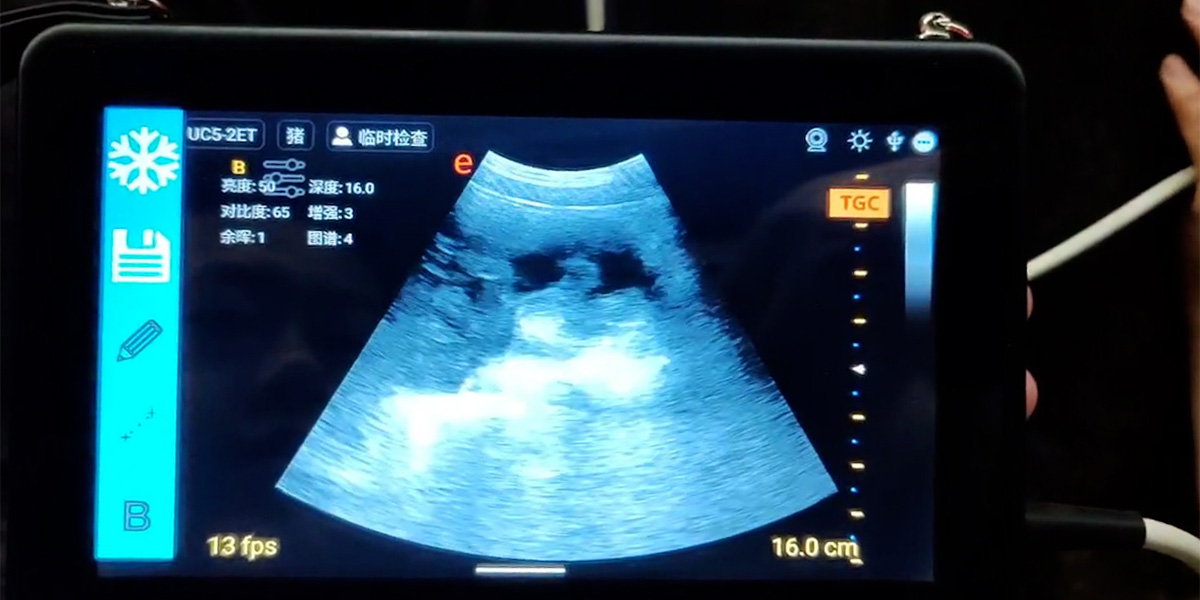
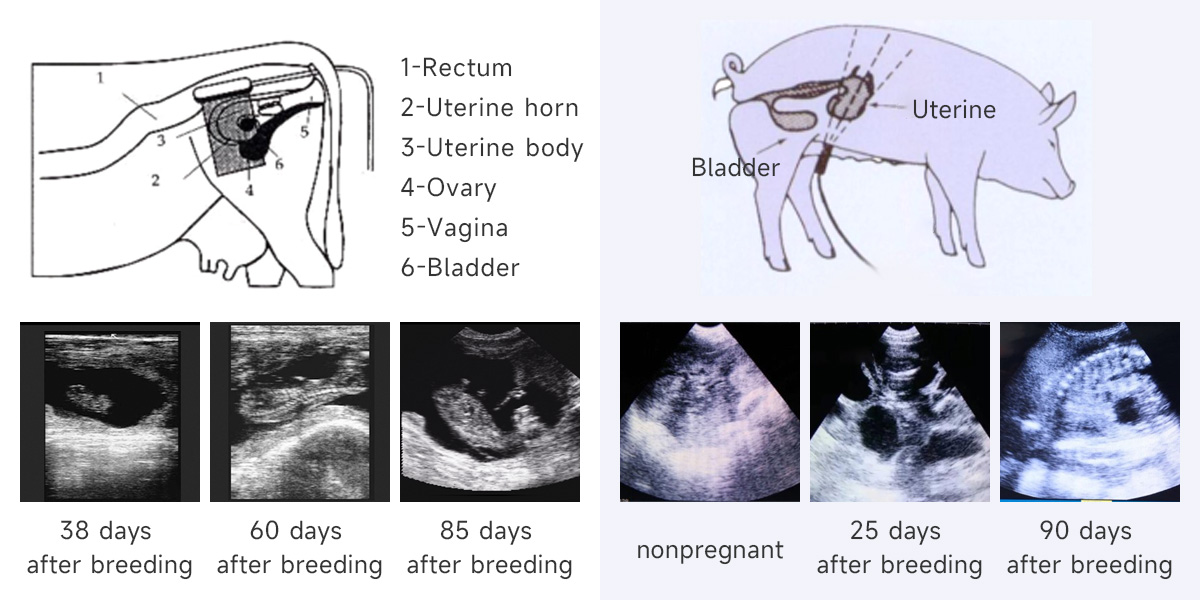
Apply coupling agent to the probe to isolate it from air, as ultrasound does not propagate through air (Probe Gel may also be applied to the animal's examination site). During detection, the device defaults toB-mode for pregnancy detection. Slowly move the probe in close contact with the target area to obtain optimal imaging. For sows, the examination site is located 5–10 centimetres above the second pair of teats from the rear. Position the convex probe at a 45-degree forward angle towards the uterine location.For bovine examinations, the rectal probe should be firmly pressed against the rectal wall, then moved laterally to scan the uterus. Once a suitable image is obtained, it can be frozen for saving and measurement operations, typically allowing measurement of distance, circumference, and area.
For cardiac assessment, select M-mode to measure cardiac wall motion and valve displacement.
To determine blood flow direction, switch to C-mode: red indicates flow towards the probe, blue indicates flow away from the probe.
To evaluate blood flow velocity, direction, and vascular status, employ PW mode. Analysis is based on spectral patterns, commonly used for pets such as cats and dogs.
The veterinary color Doppler ultrasound scanner from Eacenic Technology is equipped with powerful functions. It features a high-definition touch screen, is easy to operate and provides clear and accurate images. It is compatible with multiple probes and can meet the detection requirements of various animals. The whole machine is waterproof, ensuring safety in use and the service life of the equipment.
For further information, please contact:sales002@eacenic.com/+8617761201308